
First published 17 January 2026
I am not a clinician but a guideline methodology expert; you can read my full disclaimer here.
Guidelines: Why Evidence Matters
Guidelines are structured recommendations that translate the available evidence into practical guidance for clinicians and institutions. Experts contribute by interpreting the evidence, assessing its applicability, and advising on safe implementation.
Evidence-based guidelines are not perfect. They can be expensive to produce, slow to develop, and even when completed, they may not deliver the clear answers people hope for. But what’s the alternative?
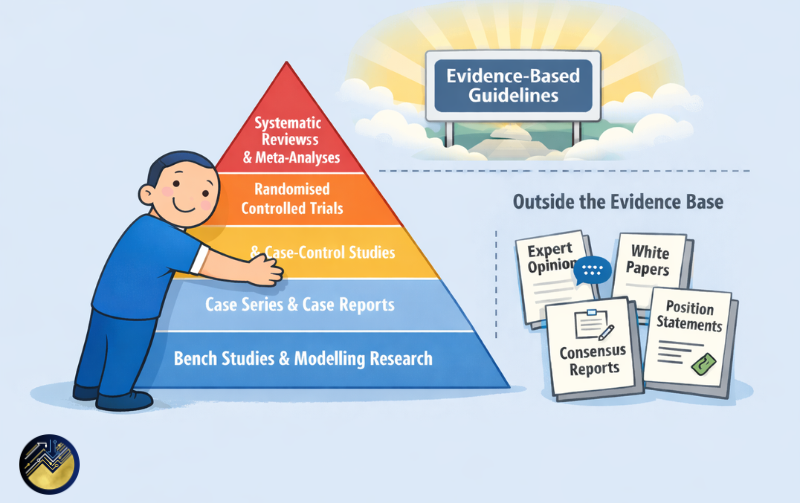
Let’s not confuse expert opinion with evidence-based advice
It may sound reassuring when an expert shares their view. But expert opinion is just that – the perspective of an individual. It may (or may not) be informed by evidence, but it is not evidence itself. Opinion is not transparent or reproducible. It is shaped by knowledge, experience, professional context, and incentives.
Who decides who the expert is? In practice, expertise is often given to visibility, seniority, or confidence rather than the quality of reasoning. And experts disagree – often loudly. Not because one is better or worse, but because the scientific literature is vast, and no one can read it all.
A classic example is the Cochrane logo: a forest plot representing an iconic systematic review on corticosteroids for women in premature labour. The review combined seven trials which were available at that time. Even if a clinician was lucky enough to come across and read all seven, they might conclude corticosteroids offered little benefit. Yet systematic analysis showed a clear advantage, likely saving thousands of lives. This demonstrates that we cannot rely on individuals alone to interpret the evidence.
Rules are not a substitute for proof
Here’s the practical tension: certain technical standards — HTMs, regulatory requirements — must be followed, even though they are not always evidence-based. It may feel like a double standard, but it reflects reality: healthcare operates within multiple frameworks. Evidence guides clinical decisions, while technical and regulatory standards ensure safety, consistency, and legal compliance.
Recognizing this distinction helps us understand the scope and purpose of different guidance types. But there’s an interesting twist: by building evidence, we can highlight where regulatory standards fall short – and the best way to do this is through guideline development. Guidelines can summarize evidence and challenge the status quo, nudging regulations toward practices that are truly evidence-based.
Embracing evidence
Healthcare organizations rely on Evidence-Based Practice (EBP) to ensure safe, high-quality, and effective care. Guidelines based on opinion, rather than evidence, risk letting down clinicians, patients, and the systems that deliver care.
In the context of guidelines, evidence means all available primary or secondary research, systematically synthesized, alongside an assessment of quality, relevance, and limitations. White papers, consensus statements, literature reviews, and opinion pieces are not evidence and should not be treated as such.
Evidence-based guidelines do not privilege one study design by default. Different types of evidence may be more appropriate for different questions. The key is transparency. Evidence does not have to be perfect to make recommendations. What matters is making uncertainty explicit, identifying gaps, and providing a shared reference point for decisions.
Even low-quality evidence can be useful. Done appropriately, guidelines offer a defensible rationale for clinical decisions and protect against arbitrary or biased choices. Guidelines don’t tell clinicians exactly what to do — they provide decision support, rationale, and a safe way to act under uncertainty. They also reassure patients, supporting shared decision-making with clear, transparent information.
Evidence alone is not enough. But it is the perfect place to start. Where would healthcare be without it? Organizations that provide advice fail their audience when they ignore evidence.
The questions everyone asks next
- What if the evidence is weak?
- What if it doesn’t exist?
- What if trials are impossible or unethical?
- What if I need advice fast?
In the next post, we’ll tackle the question that challenges every guideline developer: what do you do when the evidence is scarce — or entirely missing?
Several of the ideas discussed in this post are explored further, in practical terms, in the accompanying Practical Guidance on Guidelines articles: