
Why high-quality, evidence-based guidelines are essential
Guidelines shape how healthcare professionals make decisions about patient care. They integrate the best available evidence with expert judgement, patient perspectives, and other considerations, all interpreted through a systematically reviewed evidence base.
When that evidence base is not rigorously synthesised, decisions are less well anchored. Interpretation and opinion, including those of clinicians, patients, and other stakeholders, then carry more weight without the full context of what the evidence shows. For learned societies and professional organisations, there is also a responsibility to ensure that the guidelines they produce meet their charitable objectives by delivering high-quality advice. This is intrinsic to their role as bodies established to advance academic disciplines and uphold scientific rigour.
What’s wrong with poorly developed guidelines?
Most organisations produce guidelines or advice documents. What they often lack is a system that allows those guidelines to improve over time.
When evidence is not systematically identified, appraised, and synthesised, guideline development becomes an exercise in consensus rather than knowledge creation. Experts meet, discuss, and draw on familiar interpretations. Recommendations are updated, but the underlying process remains unchanged. Over time, this creates a closed loop:
- Ideas are repeated rather than tested;
- Updates reflect shifting opinion rather than new evidence;
- Uncertainty is not mapped, and evidence gaps remain invisible.
Because evidence is not actively synthesised, it becomes unclear:
- What is known;
- What is uncertain;
- And what needs to be studied next.
As a result, research and practice drift apart. Research proceeds without a clear understanding of what is needed, while practice evolves without a clear understanding of the evidence. The system appears stable, but it does not progress. Guidelines become static outputs of a repeating process rather than a learning system. Effort is spent maintaining the cycle, rather than advancing knowledge. Over time, this makes it increasingly difficult to justify the resources invested.
What high-quality guidelines change
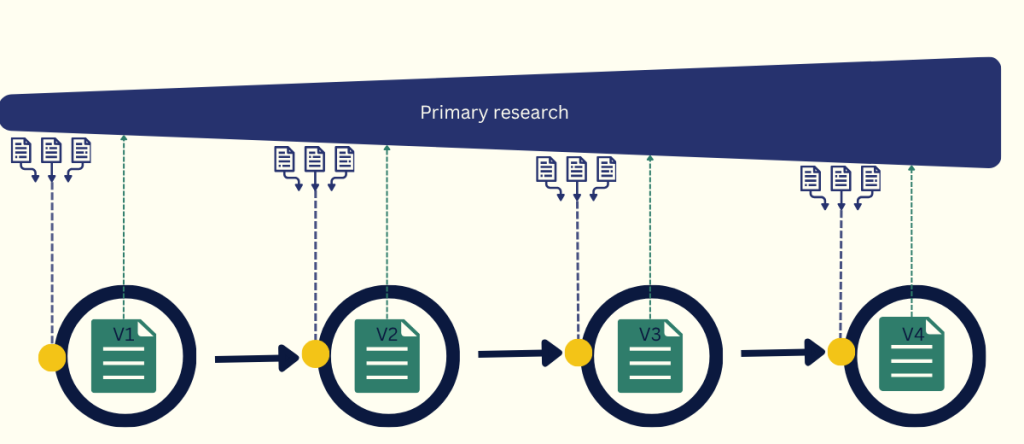
High-quality guidelines are more than evidence synthesis and recommendations. They create a structured system that connects evidence, decision-making, and implementation over time. At their core, they break the closed cycle of opinion by:
- Systematically identifying and synthesising the evidence;
- Making uncertainty explicit;
- And linking recommendations to clearly defined bodies of knowledge.
This system improves the recommendations today and tomorrow.
Robust guidelines go further than evidence synthesis alone.
They incorporate a set of frameworks that ensure decisions are not only evidence-based, but also usable, trustworthy, and implementable:
- Stakeholder integration: Recommendations are shaped by those affected by them — not just by those producing them — ensuring they are acceptable and applicable in practice.
- Conflict of interest management: Financial and intellectual influences are identified and managed, so that recommendations are made in the interest of patients, populations, and systems — not individuals.
- Structured decision frameworks: Evidence is interpreted consistently, with clear links between findings, judgements, and recommendations.
- Implementation and evaluation: Guidelines do not stop at “what to do” — they define how to act, what to expect, and how to measure progress.
Together, these elements transform guidelines from documents into infrastructure for decision-making. They create a system where evidence informs practice, practice informs research, and each cycle strengthens the one that follows. The result is not just better recommendations, but an entire system that is more consistent, more transparent and capable of learning over time. This benefits a healthcare community and the organisation that produces the guidelines.
benefits
Benefits for the Healthcare community
Guidelines provide clear, evidence-based recommendations that support consistent decisions across teams, members, and stakeholders. They reduce unwarranted variation in practice and ensure decisions are guided by evidence rather than interpretation or opinion.
They translate research into practical recommendations for real-world use, reducing uncertainty and helping to prevent avoidable harm, errors, and inefficiencies.
Well-developed guidelines demonstrate that decisions are based on structured evidence rather than opinion, habit, or commercial interests. They increase transparency by showing how recommendations are formed and what evidence has been considered.
Clear, evidence-based guidance also strengthens accountability by making decision-making processes more visible and defensible.
Guidelines do more than support current practice. By systematically reviewing and synthesising the available evidence, they clarify what is known and where important uncertainties remain. This helps identify gaps in the evidence base and informs priorities for future research.
By identifying key uncertainties and unanswered questions, guidelines help shape research priorities and strengthen the connection between research, practice, and healthcare delivery, including service design, infrastructure, and innovation. Ultimately, they contribute to a stronger evidence base that enables better-informed decisions in the future.
Benefits for the Organisations
Organisations that produce high-quality guidelines are better positioned to demonstrate expertise, leadership, and measurable impact.
They are more likely to:
- Influence policy, standards, and professional practice;
- Attract partnerships, funding, and collaboration opportunities;
- Gain new members and increase professional engagement;
- Build long-term trust and reputation;
- Be recognised as credible authorities in their field;
- Strengthen engagement with members and stakeholders;
- Translate organisational purpose into real-world impact;
- Fulfil their core mission by systematically advancing knowledge and practice within their field;
- Create greater opportunities to deliver on those charitable objectives through expanded influence, reach, and impact.
High-quality guidelines help learned societies and professional bodies do what they exist to do: turn evidence into structured knowledge, identify gaps, and ensure that their outputs actively shape the development of their discipline.
Key message
In environments where many organisations produce guidance, high-quality guideline producers stand out not by volume, but by rigour.